Cybersecurity
Cybersecurity: stay ahead of every threat.
Practical guides on malware, phishing, identity theft, and data protection. No jargon, just clear advice.
Cybersecurity Essentials
Bottom Line: Most cyberattacks do not require sophisticated hacking — they exploit weak passwords, unpatched software, and human error. Enable multi-factor authentication on every critical account, keep software updated, and use a password manager. These three controls eliminate the vast majority of attack vectors targeting individuals and small businesses.
Cybersecurity is the practice of protecting your devices, networks and data against digital attacks, theft and damage. It’s not just an IT problem. It’s a business survival issue that impacts your money, reputation and ability to operate.
Most people think cybersecurity only matters if you work with classified government information or run a Fortune 500 company. Not true. Hackers actively target individuals and small businesses because they assume these targets have fewer defenses.
The good news? You don’t need a computer science degree. You just need to understand what you’re dealing with and what defenses actually work.
How Cyberattacks Usually Happen?
Most cyberattacks follow a predictable pattern. Understanding this pattern helps you identify your weakest points and where simple defenses have the most impact.
The Attack Chain
| Stage | What Happens | Timeline |
|---|---|---|
| Reconnaissance | Hackers profile you via your website, LinkedIn and exposed systems | Days to weeks |
| Entry | They get in through phishing, unpatched software or stolen credentials | Seconds to minutes |
| Access Expansion | They escalate privileges, plant backdoors and move silently through your network | Weeks to months |
| Impact | Ransomware, stolen data, crippled ops damage is done before you notice | Variable |
Most Common Entry Points
- Weak or reused passwords: Using “Company2024” or the same password across multiple sites leaves your front door wide open. Stolen credentials are routinely sold on dark web marketplaces, making password reuse even more dangerous.
- Phishing emails: Attackers trick individuals into providing credentials or installing malware. Modern phishing is highly persuasive and targeted, often impersonating your bank, boss, or IT vendor. Visit our phishing attacks guide for detailed defense strategies.
- Unpatched software: That update notification you’ve been ignoring? Attackers already have automated tools scanning for that exact vulnerability.
- Misconfigurations: Cloud storage exposed to the public, admin panels accessible over the internet or unchanged default passwords are easy entry points. Public Wi-Fi networks add another layer of risk, as attackers on the same network can intercept unencrypted traffic in real time.
Why Attackers Target People, Not Just Technology?
Here’s the unpleasant truth: your employees often become the weakest link. Not because they are careless but because humans are predictable and exploitable in ways technology is not.
Social engineering is devastatingly effective. Attackers don’t need to crack 256-bit encryption when they can send an email appearing to be from your CEO requesting an urgent wire transfer. Online scams like these exploit trust, urgency and authority more effectively than any technical vulnerability.
The CIA Triad: Core Goals of Cybersecurity
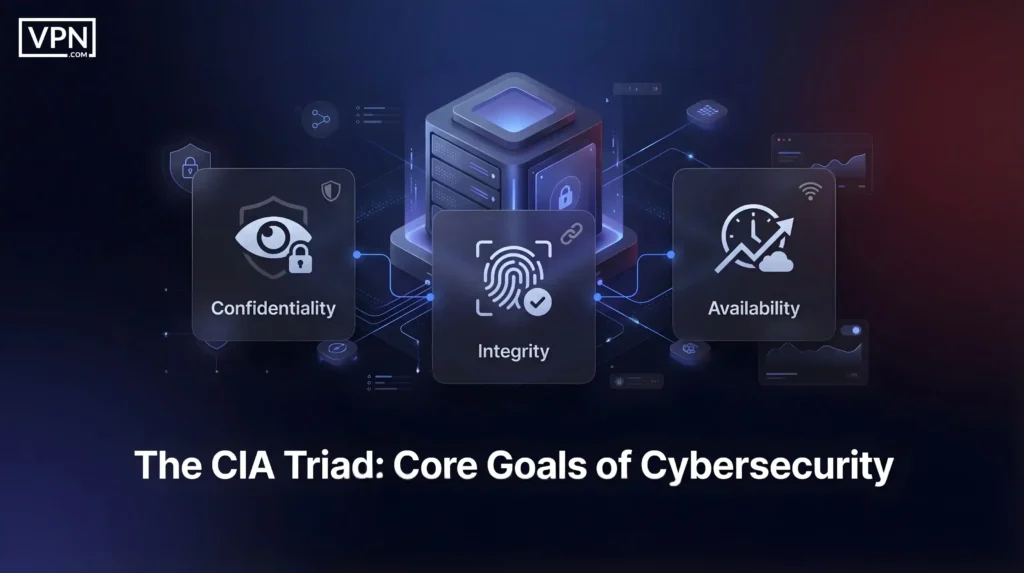
Cybersecurity reduces to three fundamental objectives, known as the CIA triad (unrelated to intelligence agencies):
| Goal | Definition | Attack Example | Impact |
|---|---|---|---|
| Confidentiality | Sensitive data accessible only to authorized people | Data theft, credential leaks, compromised customer info | Fines, lost trust, competitive damage |
| Integrity | Information stays accurate and unaltered | Modified records, rerouted emails, malware-infected software | Silent fraud, corrupted systems |
| Availability | Systems and data accessible when needed | Ransomware, DDoS, service disruption | Revenue loss, operational shutdown |
Most businesses prioritize availability above all else. A breach you can eventually recover from is manageable; being offline for days is catastrophic.
Biggest Cyber Threats Today
- DDoS and Service Outages: Attackers use botnets to flood your servers with traffic, causing them to crash. Your website, email and business applications become inaccessible. The economic cost is direct: e-commerce sites lose money every minute offline, SaaS providers violate SLAs and customer confidence erodes with each hour of downtime.
- Supply Chain Attacks: You have secured your own systems, but what about your vendors? Attackers compromise software updates, managed service providers or cloud platforms you trust. The SolarWinds attack compromised a software update used by 18,000 clients, including government agencies and Fortune 500 companies. Victims did nothing wrong; they just trusted their vendor.
- AI-Powered Attacks: AI has turned every attacker into an expert at phishing emails that now reference your recent activity, deepfakes impersonate your CEO’s voice and automated tools scan millions of systems for weaknesses in real-time. What once required sophisticated skills is now a cheap, off-the-shelf toolkit on criminal forums.
Types of Cybersecurity
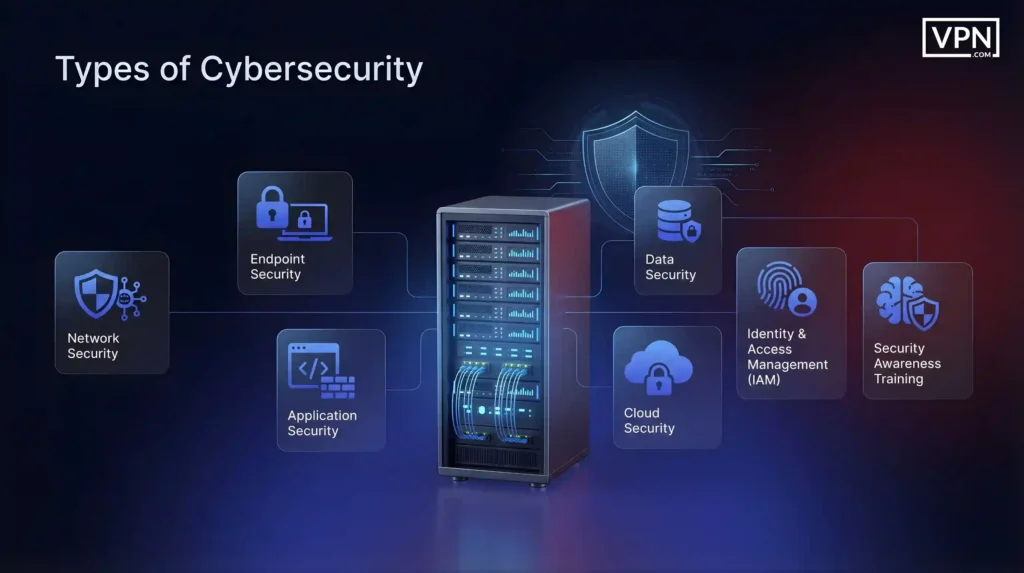
Cybersecurity encompasses multiple specialized disciplines:
| Discipline | What It Protects | Key Technologies |
|---|---|---|
| Network Security | Routes your data travels | Firewalls, VPNs, intrusion detection systems, network segmentation |
| Endpoint Security | Devices accessing your network, laptops, phones, servers | Antivirus, device encryption, patching, mobile device management |
| Application Security | Software you develop or use like websites, apps, APIs | Secure coding, vulnerability testing, defenses against injection attacks |
| Cloud Security | Risks unique to cloud environments | Access controls, encryption, shared responsibility model compliance |
| Data Security | Information itself, regardless of location or transit | Data classification, encryption, data loss prevention |
| Identity & Access Management (IAM) | Who can access what | Authentication, MFA, role-based access, least privilege principle |
| Security Awareness Training | Human behavior and decision-making | Phishing recognition, authentication protocols, incident reporting |
These disciplines don’t operate in isolation. A zero trust security model ties many of them together by treating every access request as untrusted by default, regardless of where it originates.
Cybersecurity vs Information Security vs IT Security
These terms are often used interchangeably, but understanding the differences is useful when hiring, buying tools, or developing policies.
| Term | What It Covers | Focus Area | Example Responsibilities |
|---|---|---|---|
| Cybersecurity | Protection against digital threats and attacks | Threat-based defense in connected environments | Stopping hackers, detecting breaches, responding to ransomware |
| Information Security (InfoSec) | Protection of all information assets, regardless of format | Data protection across all states and media | Confidential documents, encryption, compliance |
| IT Security | Protection of technology infrastructure and systems | Infrastructure and operational security | Server security, user access, patch management, firewalls |
Cybersecurity for Individuals: Essential Controls
You don’t need corporate-level tools to protect yourself. Most attacks on individuals result from simple errors avoidable through basic habits.
- Multi-Factor Authentication (MFA): Enable MFA on all accounts that support it, especially email, banking, social media and payment services. Prefer authenticator apps (Google Authenticator, Microsoft Authenticator, Authy) over SMS, which attackers can intercept via SIM-swapping. MFA prevents an overwhelming majority of account takeovers, even if your password is compromised. Without it, a single leaked password is often enough to enable identity theft.
- Software Updates: Enable automatic updates on your phone, computer, browser and applications. Security patches fix vulnerabilities that attackers actively exploit. Known weaknesses are exposed because most people delay updating. Updates occasionally cause issues, but the risk of not updating always outweighs minor inconvenience.
- Password Manager: Your brain cannot generate and retain 80+ unique passwords. Use a reliable password manager and let it generate random passwords. This eliminates password reuse. If Adobe, LinkedIn or another company is breached, stolen credentials won’t work elsewhere.
What to Do If You’ve Been Hacked
If you believe your account or device has been compromised, change passwords immediately on a separate device, reset MFA and contact your bank if financial accounts are involved. Check your email for unauthorized password reset requests, as email is the pivot point for accessing other services.
Cybersecurity: FAQs
What is cybersecurity?
Cybersecurity is the process of protecting your devices, networks and data from digital attacks, theft and damage. It’s a combination of technology, processes and awareness that keeps unauthorized individuals out of your systems.
What are the most common cyber threats?
Phishing emails, ransomware, credential theft through weak or reused passwords, DDoS attacks, malware and social engineering that targets human trust rather than technical weaknesses.
What is MFA and why is it important?
Multi-factor authentication requires two or more verification methods to access an account. It prevents 99.9% of automated credential attacks. Even if attackers steal your password through phishing or breaches, they can’t access your account without the second factor.
Does antivirus protect against everything?
No. Antivirus catches known malware signatures and suspicious activity, but won’t stop phishing emails, weak passwords, misconfigurations or zero-day exploits. Consider it one line of defense, not complete protection. Combine it with MFA, patching, backups and security awareness.
Why do attackers target individuals if they’re not important?
Attackers use automated tools to search millions of accounts for weak passwords, missing MFA and unpatched devices. It’s not personal; you’re part of a broad net hoping to catch any weak target. Simple controls make you significantly harder to crack than millions using “Password123.”
The Bottom Line
Cybersecurity isn’t about perfect protection. It’s about systematically reducing risk until you’re no longer the easiest target. When you think about everything you haven’t done, cybersecurity becomes overwhelming. When you focus on the right priorities, it becomes manageable.
Attackers search for easy targets. Any fundamental control you implement removes you from that pool. You don’t need to be impenetrable, just more secure than thousands of targets who haven’t done the basics.
The threat landscape will continue evolving. New attacks will emerge. But the fundamentals remain constant: secure access, maintain visibility, contain harm and recover quickly. Master those and you’ll be positioned to adapt as threats change.
Cybersecurity: FAQs
Is antivirus software enough to protect me?
What is the difference between a VPN and antivirus?
What is zero trust security?
How do I spot a phishing email?
What are the best password practices in 2026?
Latest Cybersecurity Guides
Best Antivirus Software: Tested & Ranked
We tested the best antivirus software against real threats. Bitdefender leads with perfect lab scores, Norton for privacy, ESET for speed. Find your match.
The Top Online Scams: You Can’t Afford to Ignore
Think you’re safe? Online scams are getting sneakier by the day. Don’t be their next victim! Learn the latest scam tactics & how to fight back. Click to Read!
Passwords Leak: Causes, Risks & How to Stay Safe
Learn why passwords leak, the risks to your accounts, and proven defenses like strong unique passwords and two-factor authentication to protect yourself.
Dark Web vs Deep Web: Key Differences
Dark web vs deep web: understand what separates them. The deep web holds your email and banking data. The dark web requires Tor and carries serious risks.
Data Protection: Tips, Strategies & Cybersecurity Guide
Protect your data with proven data protection strategies, tips, and cybersecurity measures for individuals and businesses.
Zero Trust Cyber Security: Principles & Implementation
Learn zero trust cyber security basics, how the model works, key benefits, and practical steps to shift from perimeter defenses to always-verify access.
Start with the basics.
Public Wi-Fi is one of the fastest ways attackers get in. Learn the risks and the simple steps that keep you safe on any network.
Read the public Wi-Fi guide