We connected 3,161 people with a VPN this week
Find the right VPN provider for youThe best VPN providers for security.The best VPN providers for streaming.The best VPN providers for gaming.The best VPN providers for teams.The best VPN providers for privacy.The best VPN providers for torrenting.The free VPNs that are actually worth using.
What is the main reason you're shopping for a VPN?Explore top VPN providers for:

- Top encryption and threat-protection scores in our tests
- Independently audited no-logs policy
- Built-in threat protection blocks trackers and malware
30-day money-back guarantee

- Swiss-based, independently audited no-logs
- Built-in NetShield ad and malware blocker
- Free tier lets you test the network first
- Fastest speeds for HD and 4K in our tests
- Reliable access across regions
- Encrypted traffic your ISP can’t single out to throttle
30-day money-back guarantee

- Consistently fast for HD and 4K
- Servers in 100+ countries
- Reliable across major streaming regions
- Masks your real IP so opponents can’t target you
- Stable connections that hold under load
- Sidesteps ISP throttling on your route
30-day money-back guarantee
- Masks your IP from opponents in-match
- Fast, stable routing under load
- Apps for PC, mobile, and console via router
- Central management built for teams
- Reliable uptime at scale
- Encrypted, authenticated access to company systems
30-day money-back guarantee
- Simple apps non-technical staff can use
- Servers in 100+ countries for distributed teams
- 24/7 support when something breaks
- Independently audited no-logs policy
- Privacy-first by design
- Your ISP sees only encrypted traffic to one server
30-day money-back guarantee

- Anonymous accounts — no email required
- Flat €5/mo, cash accepted
- Independently audited, open-source apps
- Top P2P speeds in our tests
- Hides your IP from everyone else sharing the file
- Proven no-logs privacy for file sharing
30-day money-back guarantee

- Unlimited devices on one plan
- P2P-friendly servers
- Fast speeds for large transfers
- Access every major streaming service
- Full speed, no throttling
- Servers in 100+ countries
- Protects up to 10 devices at once
- Independently audited no-logs policy
- P2P and torrenting fully supported
- Kill switch and 24/7 support
30-day money-back guarantee
- No access to streaming services
- One device at a time
- Slower, deprioritized speeds
- Few locations, no server choice
- No P2P or torrenting
- Data caps on most free plans
- Many free VPNs monetize your data
The top VPNs, comparedThe top VPNs compared for securityThe top VPNs compared for streamingThe top VPNs compared for gamingThe top VPNs compared for teamsThe top VPNs compared for privacyThe top VPNs compared for torrentingThe top VPNs compared for free plans
- Independently tested every monthIndependently rated for securitySpeed-tested for streamingLatency-tested for gamingIndependently rated for enterpriseIndependently rated for privacySpeed-tested for torrentingVerified for free plans
- Top-rated in your region
- Optimized for every device
| # | Provider | Reviews | Speed | Latency | Loss | Consistency | PriceFree plan | Best DealBest paid plan | |
|---|---|---|---|---|---|---|---|---|---|
| 1 | ★ Best for Security★ Best for Streaming★ Best for Gaming★ Best for Teams★ Best for Privacy★ Best for TorrentingNordVPN | 4.66(2.0M) | 730 Mbps | 18 ms | 0.1% | 98% | $14.99/mo | $3.49/mo2-year plan | Read Review |
| 2 | ★ Best Free VPNProtonVPN | 4.61(1.2M) | 580 Mbps | 22 ms | 0.2% | 96% | $9.99/mo✓ | $2.49/mo2-year plan $2.49/mo$9.99/mo | Read Review |
| 3 | Mullvad VPN | 4.14(9K) | 650 Mbps | 20 ms | 0.1% | 97% | $5.50/mo | $5.50/mo1-month plan | Read Review |
| 4 |  CyberGhost CyberGhost | 4.23(207K) | 612 Mbps | 25 ms | 0.2% | 94% | $12.99/mo | $2.03/mo2-year plan | Read Review |
| 5 | ExpressVPN | 4.68(889K) | 630 Mbps | 22 ms | 0.1% | 97% | $12.95/mo | $3.49/mo1-year plan | Read Review |
| 6 |  PIA PIA | 4.69(255K) | 620 Mbps | 24 ms | 0.3% | 95% | $11.95/mo | $2.03/mo2-year plan | Read Review |
| 7 | Surfshark | 4.71(397K) | 695 Mbps | 20 ms | 0.2% | 97% | $15.45/mo | $1.99/mo2-year plan | Read Review |
| 8 |  TotalVPN TotalVPN | 4.28(3K) | 480 Mbps | 102 ms | 1.2% | 79% | $14.92/mo | $1.59/mo1-year plan | Read Review |
| 9 |  PureVPN PureVPN | 4.36(50K) | 700 Mbps | 20 ms | 0.1% | 97% | $12.45/mo | $2.14/mo2-year plan | Read Review |
| 10 |  Windscribe VPN Windscribe VPN | 4.64(324K) | 420 Mbps | 28 ms | 0.3% | 92% | $9.00/mo✓ | $5.75/mo1-year plan $5.75/mo$9.00/mo | Read Review |
| 11 |  IPVanish IPVanish | 4.55(174K) | 690 Mbps | 25 ms | 0.1% | 97% | $12.99/mo | $2.19/mo2-year plan | Read Review |
| 12 |  Hide.me Hide.me | 4.52(45K) | 680 Mbps | 38 ms | 0.2% | 96% | $9.95/mo✓ | $2.69/mo2-year plan $2.69/mo$9.95/mo | Read Review |
| 13 |  Astrill VPN Astrill VPN | 3.75(8K) | 400 Mbps | 180 ms | 0.6% | 75% | $30.00/mo | $12.50/mo2-year plan | Read Review |
| 14 |  Bitdefender VPN Bitdefender VPN | 4.81(68K) | 590 Mbps | 77 ms | 0.3% | 86% | $6.99/mo | $2.50/mo1-year plan | Read Review |
| 15 |  Norton VPN Norton VPN | 4.45(427K) | 450 Mbps | 120 ms | 0.8% | 60% | $4.99/mo | $2.49/mo2-year plan | Read Review |
| 16 |  PrivadoVPN PrivadoVPN | 3.38(11K) | 550 Mbps | 35 ms | 0.3% | 82% | $10.99/mo✓ | $1.11/mo2-year plan $1.11/mo$10.99/mo | Read Review |
| 17 |  TunnelBear TunnelBear | 4.68(409K) | 420 Mbps | 65 ms | 0.4% | 88% | $9.99/mo✓ | $3.33/mo3-year plan $3.33/mo$9.99/mo | Read Review |
| 18 |  Hotspot Shield Hotspot Shield | 4.57(2.0M) | 710 Mbps | 15 ms | 0.1% | 98% | $12.99/mo | $7.99/mo1-year plan | Read Review |
| 19 |  IVPN IVPN | 4.06(2K) | 520 Mbps | 45 ms | 0.3% | 83% | $6.00/mo | $6.00/mo1-month plan | Read Review |
| 20 |  VyprVPN VyprVPN | 4.7(94K) | 350 Mbps | 85 ms | 0.5% | 69% | $10.00/mo | $3.00/mo1-year plan | Read Review |
| 21 |  Avast VPN Avast VPN | 4.68(250K) | 380 Mbps | 156 ms | 1.2% | 68% | $6.99/mo | $4.39/mo2-year plan | Read Review |
| 22 |  McAfee VPN McAfee VPN | 4.72(1.1M) | 320 Mbps | 140 ms | 0.8% | 70% | $6.99/mo | $1.67/mo1-year plan | Read Review |
Our Methodology
Providers are ranked by VPN.com Trust Score — our 100-point editorial assessment across 11 criteria in two categories: Trust & Value (30 pts — user satisfaction, pricing, guarantee, support) and VPN Performance (70 pts — speed, servers, devices, protocols, streaming, security). Click any column header to re-sort.
Speed data compiled from independent testing by Security.org, Cybernews, All About Cookies, and VPN Mentor (2025–2026). All tests conducted on WireGuard where available.Full methodology →
22 providers · Last updated April 2026
Why a VPN mattersWhy a VPN matters for StreamingWhy a VPN matters for GamingWhy a VPN matters for PrivacyWhy a VPN matters for SecurityWhy a VPN matters for TorrentingBefore you settle for freeWhy a VPN matters for Enterprise
Your privacy, security, and access are only as strong as the network you’re on.
The networks you use, like your internet provider and public Wi-Fi, can see and record what you do online.
A VPN scrambles your traffic, so they only see one encrypted connection, not the sites you visit.
- Internet providers collect large amounts of your browsing, app, and location data to target ads. (FTC, 2021)
- Stolen logins were the way in for 16% of data breaches, and public Wi-Fi is one place they get taken. (IBM, 2024)
Streaming apps only show the titles licensed for your country, which is often just a slice of everything they have.
Connect through another country and your same account lets you watch a much bigger library, at no extra cost.
- The same streaming account shows a different set of titles depending on which country you connect from. (uNoGS / Statista)
- Getting more shows and movies is one of the top reasons people use a VPN. (Security.org, 2025)
In online games, other players can see your real IP address. Someone can pay about $30 to use it to knock you offline or find where you live.
With a VPN, other players see an IP address from the VPN instead of yours, so they cannot target your home connection.
- Gamers get hit by connection-flooding (DDoS) attacks more than any other group, and attacks on games jumped 94% in a year. (Akamai, 2024)
- Services that flood a target’s connection cost as little as $30 and can find them from their in-game info. (FBI)
Your internet provider can see and record every site you visit, and since 2017 there is no US rule stopping them from using it for ads.
A VPN scrambles your traffic, so your provider only sees that you connected to one server, not the sites you actually visited.
- Internet providers collect huge amounts of your browsing, app, and location data to target ads. (FTC, 2021)
- In 2024 the FTC stopped several data brokers from selling people’s exact location. (FTC)
On public Wi-Fi, other people on the same network can try to grab what you send, like passwords and messages.
A VPN scrambles everything you send, so the network only sees gibberish it cannot read.
- Most public Wi-Fi networks are not encrypted, and the FTC recommends using a VPN on them. (FTC)
- Stolen logins were the way in for 16% of data breaches, and public Wi-Fi is one place they get taken. (IBM, 2024)
Without a VPN, your IP address (which can be used to pinpoint your rough location) is out in the open. Everyone you download from, and everyone downloading from you, can see it.
With a VPN, those people see an IP address from the VPN instead of yours, and your provider only sees scrambled traffic, not what you are sharing.
- Companies join these file-sharing groups and record IP addresses to send automated copyright notices. One study even flagged devices that never downloaded anything. (University of Washington)
- A VPN hides your IP address from others. It does not change what is legal to download. (VPN.com)
Free VPNs are slower, cap your data, and give you only a handful of servers. You never really see what a good VPN can do.
Try NordVPN with its 30-day money-back guarantee. Use it in full, and if it does not justify the cost, cancel for a complete refund. The premium experience, at no real risk.
Get NordVPN →- Every NordVPN plan comes with a 30-day money-back guarantee, so you can try it in full and cancel for a refund if it is not for you. (NordVPN)
- A free plan is fine to start, but premium is faster, has no data caps, and handles the streaming, gaming, and torrenting that free tiers block. (VPN.com)
When people work from home, they often reach company systems over home or public Wi-Fi, where logins can be stolen.
A VPN puts that connection inside one secure, encrypted tunnel instead of the open internet.
- The average data breach cost $4.88M in 2024, and stolen logins were the most common way in. (IBM, 2024)
- A well-run VPN is basic protection for remote work, but an out-of-date one is a risk, so keep it updated. (Verizon, 2024)
Best choice for you: NordVPNsecurity: NordVPNstreaming: NordVPNgaming: NordVPNenterprise: NordVPNprivacy: NordVPNtorrenting: NordVPNfree plans: ProtonVPN.
Our overall #1 pick: NordVPN earned a 94/100 trust score in our monthly tests, with audited no-logs and the fastest speeds we measured.Our #1 security pick: NordVPN posted the strongest encryption and threat-protection scores in our rankings, earning a 94/100 trust score.Our #1 streaming pick: NordVPN posted the fastest streaming speeds in our rankings, with a 94/100 trust score.Our #1 gaming pick: NordVPN held the most stable connections under load in our rankings, with a 94/100 trust score.Our #1 teams pick: NordVPN delivered the most reliable connections in our rankings, with a 94/100 trust score.Our #1 privacy pick: NordVPN holds an independently audited no-logs record and a 94/100 trust score.Our #1 torrenting pick: NordVPN posted top P2P speeds in our rankings, backed by proven no-logs privacy and a 94/100 trust score.Our #1 free pick: ProtonVPN offers a genuinely usable free plan with unlimited data, and holds a 88/100 trust score.
Top trust score in our monthly tests
Independently audited no-logs policy
The fastest average speeds we measured
30-day money-back guarantee
Top encryption and threat-protection scores in our tests
Independently audited no-logs policy
Built-in threat protection blocks trackers and malware
30-day money-back guarantee
Fastest speeds for HD and 4K in our tests
Reliable access across regions
Encrypted traffic your ISP can’t single out to throttle
30-day money-back guarantee
Masks your real IP so opponents can’t target you
Stable connections that hold under load
Sidesteps ISP throttling on your route
30-day money-back guarantee
Central management built for teams
Reliable uptime at scale
Encrypted, authenticated access to company systems
30-day money-back guarantee
Independently audited no-logs policy
Privacy-first by design
Your ISP sees only encrypted traffic to one server
30-day money-back guarantee
Top P2P speeds in our tests
Hides your IP from everyone else sharing the file
Proven no-logs privacy for file sharing
30-day money-back guarantee
Unlimited data on the free plan
Independently audited no-logs
No credit card required to start
Free plan, no credit card required
Get access to exclusive offers.
Bigger savings = more money in your pocket.
Terms apply. Offers may change.
Sign up for PerksVPN Learning Center
Bottom Line: A VPN encrypts your internet connection and hides your IP address, protecting your activity from ISPs, advertisers, and hackers on public networks. For streaming, remote work, and everyday privacy, it is one of the highest-impact security tools available. Choose a provider with an audited no-logs policy, WireGuard protocol support, and servers in locations you need.
A VPN is one of the most powerful tools for protecting your online privacy, securing sensitive data and accessing the internet without restrictions.
Every time you browse the web, your activity can be tracked by your internet service provider (ISP), websites and even attackers on public networks. A VPN solves this by encrypting your connection and hiding your identity.
What is a VPN?
A VPN is software that encrypts your internet traffic and hides your real IP address by routing your connection through a private server. This keeps your online activity private and lets you browse as if you’re in a different location entirely.
For a complete technical breakdown, see our guide on what a VPN is and how it works.
Why You Need a VPN?
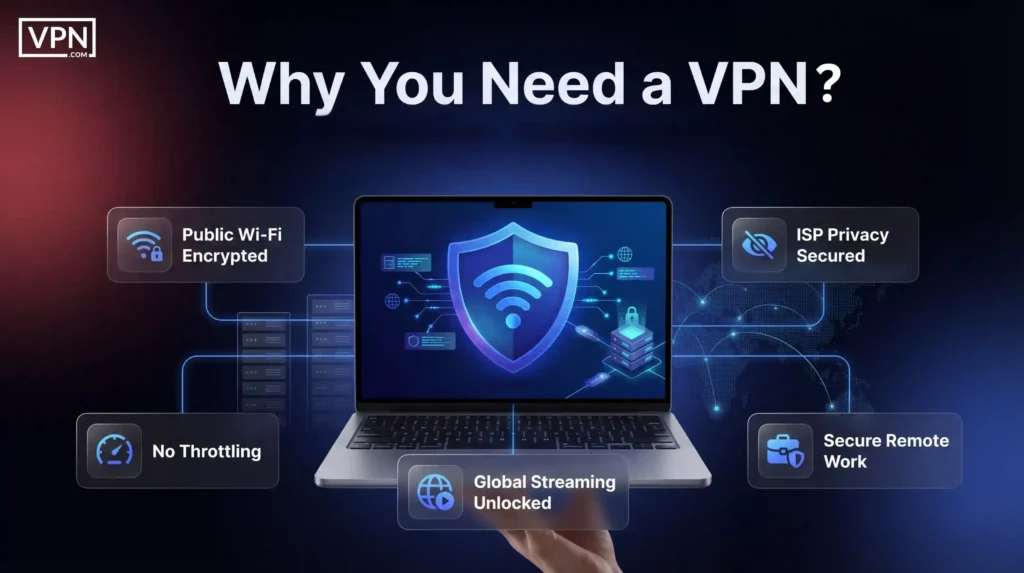
VPNs solve five critical problems that affect every internet user:
- Public Wi-Fi protection: Unsecured coffee shop and airport networks expose your passwords, banking credentials, and messages to nearby hackers in real time. A VPN encrypts everything, making it unreadable even on compromised networks.
- ISP privacy: Your internet provider logs every site you visit and sells that data to advertisers and data brokers. A VPN hides your browsing activity from your ISP, keeping your online habits private.
- Streaming access: Geo-blocks prevent you from watching your shows while traveling abroad. The best VPN for streaming lets you connect to a server in your home country, making it appear you’re still there and accessing access.
- Bandwidth throttling prevention: Some ISPs intentionally slow your connection speed during peak usage. A VPN hides what you’re doing online, so your ISP has no reason to throttle your connection.
- Remote work security: When you work from public locations or use unfamiliar networks, accessing company files and systems is risky. A VPN encrypts all work-related traffic, protecting sensitive data from interception.
VPN vs Proxy vs Tor: Key Differences
VPNs, proxies and Tor all hide your IP but work differently and suit different needs. Our VPN vs proxy guide breaks down the key differences, including when you’d choose one over the other.
How Does a VPN Work?
When you activate a VPN, your connection is encrypted and routed through a private server; the website you visit sees the server’s IP, not yours. Our VPN setup guide covers installation on every device.
How to Choose the Right VPN?
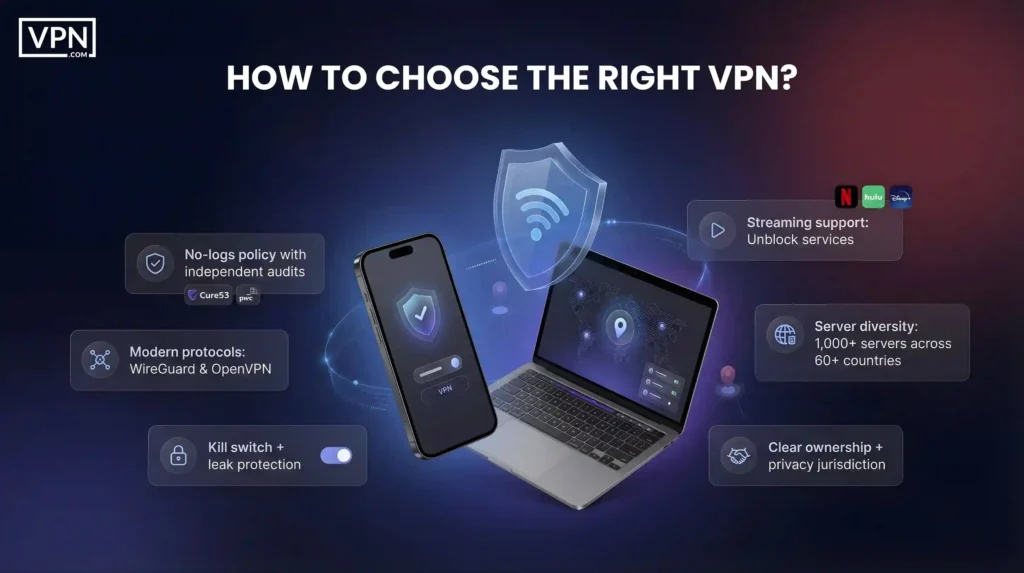
The most important factors when choosing a VPN (from no-logs audits to kill switches and jurisdiction) are covered in our “How to Choose a VPN” guide.
For specific use cases, see:
VPN Speed Testing: Real-World Performance
We’ve tested 50+ VPN providers using our Speed Lab methodology. Here’s how the top performers compare on a 1 Gbps fiber connection:
| VPN Provider | Download Speed | Speed Retention | Latency Increase |
|---|---|---|---|
| NordVPN | 730 Mbps | 73% | +12ms |
| Surfshark | 680 Mbps | 68% | +15ms |
| ExpressVPN | 650 Mbps | 65% | +18ms |
Modern VPNs using WireGuard add only 5–15% latency on broadband connections. The privacy benefit far outweighs the minor speed reduction for most users.
VPN Security & Privacy: What You Should Know
A VPN is a strong privacy tool, but it has important limits. Understanding what it protects and what it doesn’t is critical.
A VPN protects you from:
- Your ISP sees which sites you browse
- Hackers on public Wi-Fi are stealing your passwords
- Websites identifying your real location
- Your activity logs are being sold to advertisers
A VPN does not protect against:
- Malware or viruses on your device
- Phishing attacks that trick you into giving up information
- Browser fingerprinting techniques
- Third-party cookies and tracking pixels
A VPN works best as part of a broader security strategy that includes strong passwords, two-factor authentication and reputable antivirus software. For complete online security guidance, see our cybersecurity hub.
It’s also worth knowing where VPNs are legal before relying on one.
Best VPNs: FAQs
Is it legal to use a VPN?
Yes, in most countries. But a few nations restrict or ban VPNs. See our VPN legality guide for country-specific regulations.
Do VPNs slow down your internet?
Yes, because of encryption overhead and server routing. Modern VPNs using WireGuard add only 5–15% latency on broadband connections. Fiber and 5G users notice even less impact.
Can I use a free VPN?
Free VPNs often log your data, inject ads into pages or sell your information to third parties. If you want a free option, Proton VPN is the most trustworthy, though paid VPNs offer significantly better performance and features.
Which VPN protocol is best?
WireGuard is the fastest and most secure option available today. OpenVPN is rock-solid, widely trusted, and extremely compatible with older devices. IKEv2 is best for mobile users because it automatically reconnects when you switch networks.
Should I use a VPN for torrenting?
If you torrent legally, a VPN is optional. If you download copyrighted material, a VPN hides your activity from your ISP, preventing legal threats. Choose a VPN that explicitly allows P2P traffic and has a kill switch to prevent accidental IP leaks during connection drops.
The Bottom Line
A VPN encrypts your data, hides your IP address and protects your privacy on any internet connection. For public Wi-Fi security, streaming access, remote work and everyday browsing, a VPN is one of the best security investments you can make.
Choose a service with modern encryption (AES-256), a proven no-logs policy backed by audits and servers in locations you actually need. Test one with a money-back guarantee to see how it fits your life.
Ready to protect your privacy? Compare top-rated VPN providers and find the right service for your needs.
Best VPNs: FAQs
Is it legal to use a VPN?
Do VPNs slow down your internet?
Can I use a free VPN?
Which VPN protocol is best?
Should I use a VPN for torrenting?
Latest VPN Guides
CyberGhost Free Trial: 7 Days on Mobile + 45-Day Guarantee
Try CyberGhost free for 7 days on Android and iOS, or use the 45-day money-back guarantee on longer plans. Full access, no payment required upfront.
CyberGhost Pricing: Plans, Costs & Best Deals
Compare CyberGhost plans and pricing. Intro vs renewal rates, seasonal discounts, and which plan offers the best value for your needs.
Is CyberGhost Safe? Security, Privacy & Audit Analysis
Is CyberGhost safe? Independent audit results, encryption protocols, jurisdiction analysis, kill switch testing, and no-logs policy verification.
CyberGhost Speed Test: Real-World Performance Results
CyberGhost speed test: 612 Mbps on 1 Gbps fiber, ranked #10 of 22. Full protocol benchmarks and methodology.
ExpressVPN Free Trial: 30-Day Money-Back Guarantee
ExpressVPN doesn't offer a traditional free trial, but you get 30 days risk-free with its money-back guarantee. Full access across 8 devices.
ExpressVPN Pricing: Plans from $3.26/Month
Compare ExpressVPN pricing across Basic, Advanced, and Pro plans. Save up to 78% with longer commitments and get a 30-day money-back guarantee.